
HOME HEALTH PROGRAM SUPPORT
A practical guide for agencies evaluating upper arm blood pressure monitors for patient teaching, structured home monitoring, discharge support, and bulk procurement.
FDA listed ZYBS U80B | Automatic upper arm measurement | 22–42 cm cuff | Two user profiles | No required app
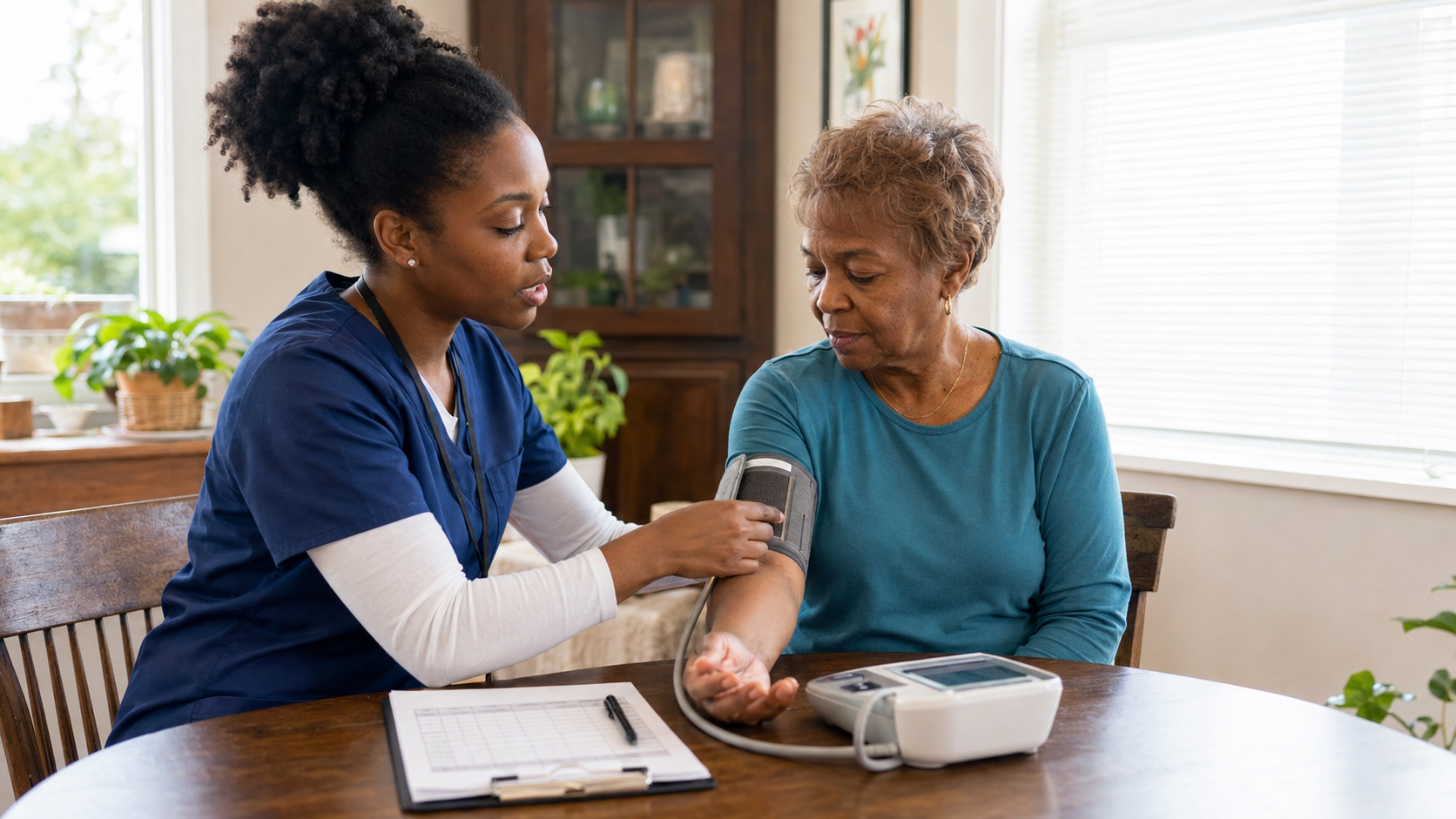
Home health agencies support patients where daily health management actually happens: at home. For patients who have been asked to monitor blood pressure outside the clinic, a well designed program can help them learn correct technique, maintain a useful record, and communicate results to the appropriate healthcare professional.
Selecting blood pressure monitors for home health agencies requires more than comparing price. Agencies should consider the intended use of the device, cuff fit, ease of operation, staff training, cleaning procedures, privacy, documentation, patient education, procurement, and a clear escalation pathway. The monitor supports the process, but the process determines whether readings are collected consistently and handled responsibly.
The role of home blood pressure monitoring
Self measured blood pressure monitoring means that a patient measures blood pressure outside a clinical setting, usually at home. The Centers for Disease Control and Prevention describes clinical support as an important part of an effective self measured blood pressure program. Support may include patient training, review of readings, follow up, and communication with the care team.
The American Heart Association recommends home monitoring for people diagnosed with high blood pressure and advises using an automatic upper arm cuff style monitor. Home measurement does not replace regular medical care, and patients should not stop blood pressure medication based on home readings without consulting a healthcare professional.
What agencies should evaluate before purchasing monitors
Intended use and regulatory information
Verify the product identity, labeling, intended use, instructions, and applicable regulatory listing. The FDA database identifies K160019 as the clearance for the U80 Series Upper Arm Electronic Blood Pressure Monitor. The FDA device listing also identifies the ZYBS Medical Upper Arm Electronic Blood Pressure Monitor, model U80B, as a Class II noninvasive blood pressure measurement system.
FDA clearance should be described accurately. It does not mean that a home monitor diagnoses hypertension, replaces clinical judgment, or is suitable for every patient. Agencies should review the current product labeling and establish whether a device fits their specific program and population.
Cuff range and patient fit
Cuff size is a clinical and operational issue. A cuff that does not fit the patient may undermine the usefulness of the measurement. Record the patient’s measured upper arm circumference and confirm that it falls within the manufacturer’s stated range. The ZYBS U80B cuff range is 22 to 42 cm. Agencies serving patients outside that range need an appropriate alternative rather than forcing the cuff to fit.
Ease of teaching and repeated use
Home health staff may have limited time to teach device operation. One button startup, a clear display, and simple instructions reduce avoidable complexity. English voice guidance may support some users who have difficulty reading the screen, although agencies should consider language needs, hearing ability, cognitive status, and privacy.
Memory and power
Stored readings can help a patient or clinician review a recent pattern when a paper log is incomplete. The ZYBS monitor stores 199 readings in each of two user profiles. Agencies should assign one profile to the intended patient and teach the household not to mix profiles. USB C and AAA battery power options can make the device practical in different home environments.
Bulk blood pressure monitor enquiries
ZYBS Medical Group supports organizations evaluating the U80B upper arm monitor for patient education, discharge support, home use, and structured care programs. Request current pricing, availability, shipping, documentation, and product support for your planned quantity.
Build a standard home monitoring workflow
A written workflow helps nurses, therapists, aides, patients, and family caregivers understand their roles. It should align with agency policy, clinician orders, scope of practice, applicable law, payer requirements, and the patient’s individualized care plan.
- Confirm the purpose. Identify why home monitoring has been requested, who will review the readings, and the intended duration.
- Assess the user. Consider arm circumference, vision, hearing, dexterity, cognition, language, positioning ability, and caregiver availability.
- Assign the device. Record the model, serial or inventory identifier where applicable, cuff range, issue date, and whether ownership transfers to the patient.
- Teach correct technique. Demonstrate preparation, rest, posture, cuff placement, quiet measurement, repetition, and recording.
- Use teach back. Ask the patient or caregiver to demonstrate the process and explain what they will do with the results.
- Document the plan. Record the schedule, reporting route, contact details, and clinician supplied escalation instructions.
- Review performance. Check technique and the reading log at follow up. Reinforce education when positioning or recording is inconsistent.
- Close the loop. Define what happens to the monitor and stored information when the episode of care ends.
A practical staff teaching checklist
The CDC’s measurement guidance emphasizes a supported back, feet flat on the floor, the arm resting at chest height, the cuff against bare skin, and no talking. The American Heart Association also advises avoiding smoking, caffeine, and exercise for 30 minutes before measurement, resting quietly for at least five minutes, and measuring at consistent times according to professional guidance.
- confirm the patient has followed preparation instructions
- use a chair that supports the back
- keep feet flat, legs uncrossed, and the body relaxed
- support the bare upper arm at heart level
- align and fasten the correctly sized cuff as instructed
- avoid conversation, phone use, and movement
- take the number of readings ordered or recommended
- record the date, time, systolic pressure, diastolic pressure, pulse, symptoms, and relevant notes
- share readings through the agency’s approved process
Agencies can reinforce this teaching with How to Measure Blood Pressure Correctly at Home and How to Interpret Blood Pressure Readings.
Documentation, privacy, and data handling
A monitor’s local memory is useful, but it is not automatically an electronic health record. Agencies should define what information belongs in the official clinical record, who transcribes or verifies it, how patient generated readings are labeled, and how discrepancies are handled.
- use only approved communication and documentation systems
- avoid photographing or texting readings through personal accounts
- separate profiles when two household members use one monitor
- protect paper logs during transport and storage
- obtain appropriate consent before involving family caregivers
- follow agency retention and disposal policies
- do not promise that offline memory is equivalent to secure clinical data storage
The ZYBS U80B does not require a mobile application or cloud account for routine operation. That can reduce setup barriers, but readings must still be communicated through the process established by the agency and treating professional. Read Your Vitals, Your Business for more information about local memory.
Cleaning, reuse, and inventory control
Before sharing or reissuing a device, review the manufacturer’s cleaning instructions and the agency’s infection prevention policy. Do not immerse the monitor or cuff, use an unapproved chemical, or reuse a product designated for single patient use. Inspect the cuff, tubing, connector, display, battery compartment, and power cable for damage.
An agency inventory process may include receiving inspection, lot or serial tracking where applicable, assignment records, staff training materials, patient acknowledgement, cleaning status, return assessment, damaged device quarantine, and replacement criteria. Confirm warranty and support arrangements before a large purchase.
Escalation and clinical boundaries
Home health staff should not invent a universal response threshold for every patient. The plan should state who receives routine results, which findings require a same day call, and which symptoms require emergency action. It should also address failed measurements, suspected device problems, missed readings, and patients who cannot use the equipment safely.
Call 911 for signs of a medical emergency, including chest pain, severe shortness of breath, fainting, sudden weakness or numbness, new confusion, difficulty speaking, or a sudden severe headache. Do not allow repeated measurements to delay emergency assessment. A monitor informs care, but it does not diagnose the cause of symptoms.
Questions for a potential monitor supplier
- What is the exact model and intended use?
- What FDA clearance and device listing information applies?
- What arm circumference does the included cuff cover?
- Are instructions and patient education materials available?
- What power accessories are included?
- How many readings are stored and how are user profiles separated?
- What are the current unit price, bulk price, availability, and shipping terms?
- What warranty, return, replacement, and technical support processes apply?
- What cleaning method does the manufacturer specify?
- Can the supplier support a pilot before wider deployment?
Frequently asked questions
Can home health agencies use a home blood pressure monitor during visits?
Agencies should determine device suitability through their clinical leadership, policies, product labeling, and applicable requirements. A home monitor may support patient teaching and a structured home monitoring plan, but it does not replace professional assessment or agency approved clinical equipment when that is required.
Can one monitor be used for multiple patients?
That decision depends on product instructions and agency infection prevention policy. If reuse is permitted, the agency needs an approved cleaning, inspection, tracking, privacy, and reissue process. A two user memory feature is intended to separate two user histories, not to serve as a multi patient clinical record.
Does the ZYBS monitor automatically send readings to the agency?
No. The U80B works without a required Bluetooth connection, mobile application, or cloud account. Readings can be viewed on the display and retained in local memory. Agencies need a separate approved workflow for receiving and documenting results.
How should an agency start?
Begin with a defined patient group, clinical owner, written protocol, staff training, supply process, documentation route, and outcome measures. A small pilot can reveal cuff fit, teaching, adherence, support, and workflow issues before wider purchasing.
A practical device within a responsible program
The right blood pressure monitors for a home health agency should be easy to teach, appropriately sized, clearly documented, and supported by a safe workflow. The ZYBS U80B combines automatic upper arm measurement, a 22 to 42 cm cuff, one button operation, voice guidance, a large display, two user memory, and flexible power options.
ZYBS Medical Group can discuss product specifications, current availability, bulk requirements, and support materials for agencies evaluating a structured home monitoring initiative.
Medical and operational disclaimer: This article provides general education and procurement considerations. It does not replace clinical judgment, product labeling, agency policy, legal advice, payer requirements, or instructions from a licensed healthcare professional.